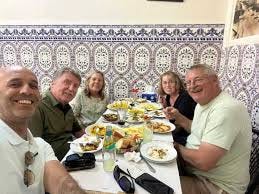
"let's do lunch"
and other lies


I was raised with the handicap of language: by that, I mean language—words—were the most singular means by which I …was me. Action only second. But you said Black Beauty was your favorite book, not Charlotte’s Web—I can hear my mother almost reprimand me—maybe at age eight, for not standing by my word. For changing it. As a result I think a lot about what I say and what I have said and I am grateful to her for this occupational hazard. But as a result, I also find myself at a loss how to navigate the world of verbal intentions—the “you know what I means?” Do I? And I’m completely unmoored when faced with a lie.
All the colors of lies.
The white ones to avoid unnecessarily hurting someone’s feelings; blue ones law enforcement will make to protect another blue uniform and; finally, the dark ones—which are the worst. The ones that betray love, destroy trust, leave permanent scars. Sweetly coated so you swallow them down only to stand dumb-founded before the incongruencies that at some point follow, causing your head to spin. That telling moment when actions and words lay parted before you like a pair of railroad tracks—as far back and forward as you can see—provided you haven’t hunkered down in a valley of blind trust like the one I inhabited while married before my head also finally started to spin. Because some people use words to hide who they are and what they are doing. Who knew!
But there’s another kind of lie out there that doesn’t have a color. Yet. The let’s do lunch lie. Let’s do lunch lies rarely actually involve lunch—or any meal, for that matter. In fact, you could think of them as a tacit decline of lunch or any future shared meal while uttering the very intention of one which is what makes them lies. Let’s do lunch lies brighten us, momentarily. We hear them and gladden. And just as quickly recoil. Let’s do lunchers inhabit our desire for connection, for friendship, for love. Then spurn them.
Unwittingly—or so I hope.
These days people are over-loaded with connections—not necessarily lasting or quality ones, but the buzzes and whistles and dings are steroidal compared with the solitary ring of an old rotary phone. And so maybe connection overload is the root cause of a let’s do luncher’s lunch-feint. The irony in having so many connections one cannot actually connect.
Humans aren’t the only masters at feinting and feigning. Animals wage rampant acts of deceit within their species and also across species. They mislead, cheat and lie all the time. The jay that mimics a red tail hawk, sending song birds deep into the thickets for cover only to move in on the berry bush. Some animals deceive their own species as well, like the male cuttlefish who enters the courtship ring by tucking his extra tentacle into his center and coloring himself female on the side of his body facing the courting male while displaying attracting male colors to the female on the other side, then making his move. But all the lies and deceptions I know in the animal world are intrinsic to survival. And while some anthropologists argue that dark human (male) lies are also a means of survival—a spreading of the seed—whether adultery is cultural or biological is another discussion. The point is that I could find no let’s-do-lunch parallel in the animal world. No false offer of affinity like the one I was extended while visiting my Amazigh (preferred name for Berber) friend here in Morocco.
I crossed the Atlas mountains with my friend almost eight year ago over a period of three weeks on foot with a mule to carry our supplies. Free from cell phone reception and the demands of other trekkers, I got to know my solitary companion, a young mountain guide on the cusp of manhood, filled with questions about the complexities of the outside world and its norms. Questions he’d gathered about the people he observed as he guided them through his mountains. Like the Italian couple he had to walk between in an attempt to keep the peace only to witness the woman run past him and slap her partner across the face. The French family who turned around mid-trek because they’d had enough of the barren vistas. Or the American couple in an open relationship who had invited him to join them in their tent. I became his trusted teacher during those weeks we walked and talked. Passing hours in silence in each other’s company. He came to confide in me regularly over the years during which time he established his own guiding company, moved to the bustling city of Marrakesh, hired employees, and added a few cell phones to his pockets.
Still, you can imagine my surprise after meeting up with him again here in Morocco and finding myself on the receiving end of a let’s-do-lunch juke. From him! In less than eight years, my friend had learned how to seamlessly exit (and re-enter) his Amizagh world and deliver the false messaging of this one with jaw-dropping dexterity. Holy shit. Was he even aware of his transformation? I later asked him. He answered me with the familiar thoughtfulness and consideration he’s always had: we all must change to survive, he wrote back.
And he’s probably right. Two cell phones, three websites and a battery of synched up instagrams later, who would actually have time for lunch? The hope being, I guess, that I’ll wave back at him in response to this bizarre new idiom for see you later.
But unlike my Amazigh friend, I can’t do lunch without actually doing lunch, and I guess that is how I survive this connection-saturated world.